Skip to content

Hip Pain When Walking: When Chiropractic and Physical Therapy Can Help

Paved walking path through a Southwest Florida neighborhood at sunrise
Hip pain that flares with every walk does not have to end your routine. Learn the common causes of walking-related hip pain and how chiropractic care and physical therapy at Grace Medical in North Fort Myers may help you move comfortably again.

Share This Post

A morning walk along the Caloosahatchee or an evening loop through the neighborhood should feel good, not like a negotiation with your own body. Yet for many adults in North Fort Myers, Cape Coral, and the surrounding communities, an aching hip turns every outing into a calculation of how far is too far. If you have started researching hip pain when walking treatment options, you are far from alone — hip discomfort is one of the most common reasons otherwise active adults quietly give up the exercise they enjoy most.

The encouraging news is that many cases of walking-related hip pain respond well to conservative, non-surgical care. At Grace Medical, Dr. Amy Kerr and her team combine chiropractic care and physical therapy to address both the joint itself and the movement habits that overload it. This article walks through the common causes of hip pain during walking, what a thorough evaluation involves, and the role each type of care can play — so you can make an informed decision about your next step rather than simply pushing through the ache.

Why Hips Often Hurt During Walks

The hip is a deep ball-and-socket joint stabilized by some of the strongest muscles in the body. When everything moves well, those muscles absorb thousands of small impacts per mile without complaint. When something is irritated, walking is usually the first activity to expose it, because each stride loads the joint repeatedly and predictably. According to the resources gathered at MedlinePlus, a service of the National Library of Medicine, hip problems range from arthritis and bursitis to tendon and nerve issues, and they often share overlapping symptoms.

Several culprits show up again and again in the clinic:

  • Osteoarthritis, which tends to produce a deep groin ache and morning stiffness that eases once you get moving.
  • Gluteal tendinopathy, an irritation of the tendons on the outside of the hip that often flares when climbing stairs or lying on the affected side.
  • Bursitis, an inflamed cushioning sac that creates sharp, localized tenderness over the bony point of the hip.
  • Referred pain from the lower spine or sacroiliac joint, which can masquerade convincingly as a hip problem.
  • Muscle imbalances and old injuries that subtly change how weight transfers through the leg with every step.

Where the pain shows up offers useful clues. Discomfort felt in the groin more often points to the joint itself, pain along the outer hip suggests tendon or bursa irritation, and an ache in the buttock that travels down the thigh frequently traces back to the spine. None of these patterns is definitive on its own, which is exactly why a hands-on examination matters before settling on a plan.

Chiropractic treatment table and instrument cart in a Grace Medical exam room

The Hip and Lower Spine Work as a Team

One of the most common surprises for new patients is learning that the source of their hip pain is not always the hip. The lumbar spine, pelvis, and hip joints function as a coordinated unit during walking. If one segment is stiff or unstable, its neighbors pick up the slack, and the extra workload eventually shows up as pain somewhere along the chain.

This relationship runs in both directions. A genuinely irritated hip changes the way you walk, and that altered gait can stress the lower back and even the knee on the opposite side. Patients who limp for a few weeks often arrive with two or three complaints layered on top of one another. Untangling which problem came first — and which ones are simply compensations — is a central goal of the first visit, because treating a compensation while ignoring the original driver rarely produces lasting relief.

What an Evaluation at Grace Medical Looks Like

Dr. Kerr’s team starts with a detailed history: when the pain began, what makes it better or worse, how far you can walk before symptoms appear, and what your typical week of activity looks like. From there, the examination typically includes watching you walk, checking hip and lumbar range of motion, testing muscle strength around the pelvis, and using orthopedic tests that help distinguish joint, tendon, and spine-related pain from one another.

If you are not sure whether your symptoms even warrant a visit, the clinic’s online symptom quiz is a low-pressure way to organize what you are feeling before you pick up the phone. And when an examination raises questions that hands-on testing cannot answer — significant trauma, night pain that does not change with position, or symptoms that keep worsening despite rest — the team refers out for imaging or a medical workup rather than guessing. Educational content like this article is a starting point, not a substitute for an in-person evaluation.

How Chiropractic Care May Help

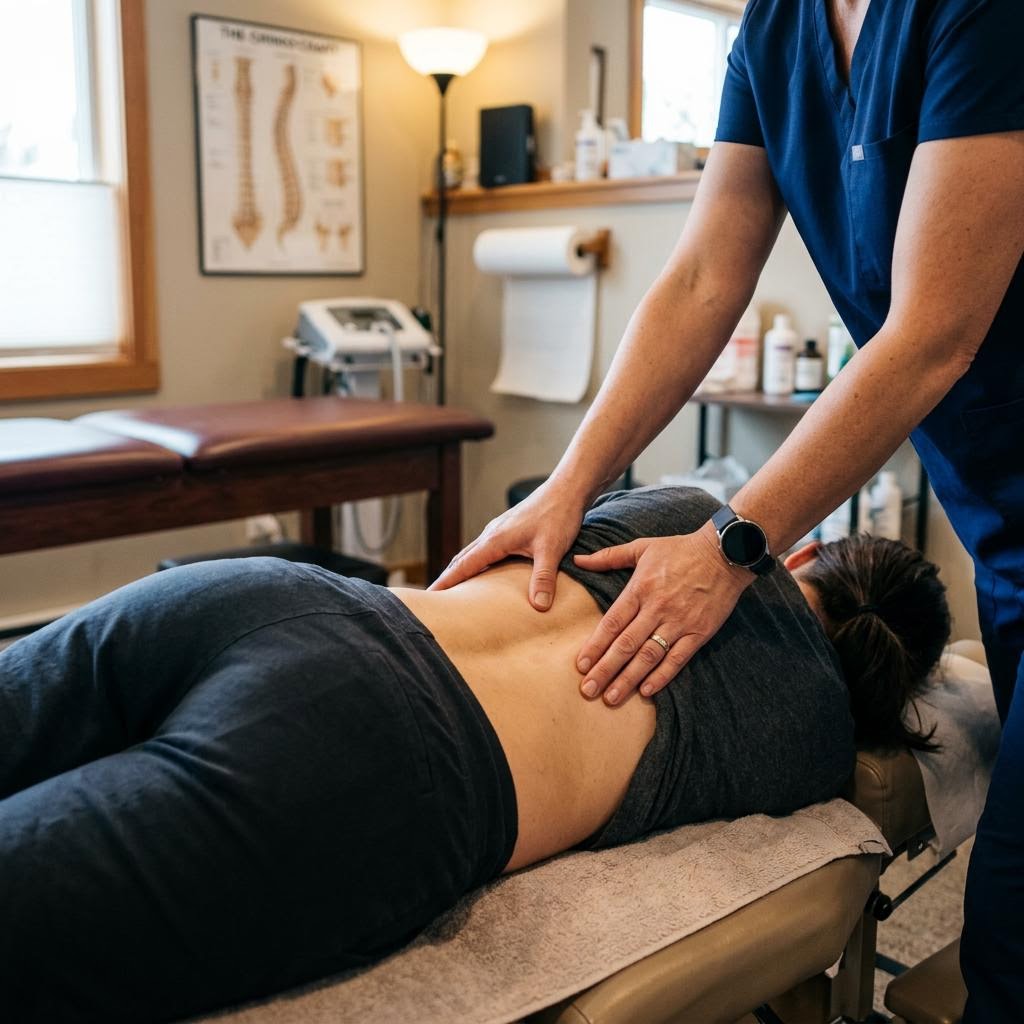
Chiropractic care for walking-related hip pain focuses on restoring normal motion to the joints that are not moving well. For some patients that means gentle, instrument-assisted adjustments to the lumbar spine and pelvis; for others it means mobilization of the hip joint itself along with soft tissue work on the muscles that cross it. The goal is not to force anything, but to remove the mechanical roadblocks that keep the joint from gliding the way it was designed to.

Patients often notice that when the pelvis and lower spine move more freely, the hip no longer has to work at the end of its available range with every stride. That reduced strain frequently translates into less irritation over the following days. Dr. Kerr’s team is careful to set realistic expectations: chiropractic care can be a meaningful part of recovery, but no single adjustment resolves a problem that took months to develop, and progress is monitored visit by visit.

The Physical Therapy Side: Strength, Mobility, and Gait

Building the muscles that protect the joint

Physical therapy picks up where hands-on treatment leaves off. The gluteal muscles, deep hip rotators, and core act as the hip’s suspension system, and when they are weak the joint surfaces and tendons absorb forces they were never meant to handle alone. A progressive strengthening program — bridges, side-lying leg work, banded walks, and step-ups, advanced gradually — gives the joint the support it needs for the long term. Many of the same principles apply to the sports injuries the clinic treats in runners and golfers, because walking is simply the lowest-intensity version of the same repetitive loading.

Retraining your stride

Strength alone is not enough if the movement pattern that caused the irritation never changes. Therapy sessions often include gait work: adjusting stride length, addressing a subtle lean or hip drop, and rebuilding tolerance with structured walking intervals instead of all-or-nothing distance goals. Patients whose pain began after a change in routine — a new job with more time on their feet, for example — often benefit from the same graded-exposure approach the team uses for work injuries.

Walking Smarter Through a Southwest Florida Summer

Foam roller, resistance band, and water bottle arranged on an exercise mat

July in Southwest Florida adds its own challenges. Heat and humidity push many walkers into the early morning or evening hours, and dehydration makes muscles crampy and less cooperative. A few practical habits protect your progress while the summer pattern of heat, afternoon storms, and high humidity settles in:

  • Walk early, before the heat index climbs, and choose shaded routes when you can.
  • Carry water on any walk longer than twenty minutes, even when it feels routine.
  • Replace worn walking shoes — compressed midsoles change how force travels up through the hip.
  • Increase distance by no more than ten to fifteen percent per week while recovering.
  • Treat a mild ache that resolves overnight as information, and a pain that lingers into the next day as a signal to scale back.

Consistency beats intensity during recovery. Three comfortable walks per week build more durable progress than one long outing that flares symptoms for days afterward.

Frequently Asked Questions

Should I stop walking entirely if my hip hurts?

Usually not. Complete rest tends to stiffen the joint and weaken the muscles around it, which can make the return to activity harder. Most patients do better shortening their walks to a comfortable distance and rebuilding gradually. That said, sharp pain, limping, or symptoms that worsen with each outing are reasons to pause and get evaluated before continuing.

How can I tell if my hip pain is actually coming from my back?

You often cannot tell from symptoms alone, which is why examination matters. Clues that point toward the spine include pain that travels below the knee, numbness or tingling, and discomfort that changes with sitting or bending rather than with walking. An evaluation that tests both regions is the most reliable way to sort it out.

How long does treatment usually take to work?

It varies with the cause, how long the problem has existed, and your overall activity level. Many patients notice meaningful change within a few weeks of consistent care, while longstanding issues can take longer. Dr. Kerr’s team reassesses progress regularly and adjusts the plan — or refers out — if results are not tracking as expected.

Take the First Step Toward More Comfortable Walks

Hip pain that shows up with every walk rarely improves by ignoring it, but it often improves with the right combination of hands-on care, strengthening, and sensible pacing. Grace Medical serves walkers, retirees, and weekend athletes from North Fort Myers, Cape Coral, and across the Fort Myers area with an approach that starts with understanding your specific problem before treating it. Call the clinic at (239) 997-8100 or request an appointment through the contact page to schedule an evaluation with Dr. Kerr’s team.

☑ Medically Reviewed by Dr. Amy Kerr, D.C. — Founder, Grace Medical & Chiropractic, North Fort Myers, FL

More To Explore

Paved walking path through a Southwest Florida neighborhood at sunrise
Pain Management

Hip Pain When Walking: When Chiropractic and Physical Therapy Can Help

Hip pain that flares with every walk does not have to end your routine. Learn the common causes of walking-related hip pain and how chiropractic care and physical therapy at Grace Medical in North Fort Myers may help you move comfortably again.

Ready to Take the Next Step?

Contact Grace Medical & Chiropractic to schedule an appointment in North Fort Myers.

chiropractor clinic